Jane Mustoe, Senior Technology Director at Tesco, joins Natalie to discuss how Tesco is using tech to redefine both customer and colleague experiences. They explore:
Tesco’s recent innovations – GetGo and frictionless shopping, gen AI chatbots, digital twins, mobile apps for store associates, and more.
All about the margins – the importance of achieving marginal gains in a low-margin industry.
Always keeping an eye on future innovations and finding pockets of “reality” amongst the “hype”.
Why over half of innovations fail, why that’s important, and lessons from Tesco’s drone trial.
Why getting the culture right is ‘make or break’ for organisations and the need to balance agility with operational efficiencies.
DEI and advice for the next generation of female tech leaders.
Centric Software provides an innovative and AI-enabled product concept-to-replenishment platform for retailers, brands and manufacturers of all sizes. As experts in fashion, luxury, footwear, outdoor, home and related goods like cosmetics, food & beverage and multi-category retail, Centric Software delivers best-of-breed solutions that optimize planning, pricing, design, product development, sourcing and production.
Find out more about the Retail Disrupted Podcast by visiting retaildisrupted.com
Retail Disrupted
Every Little (Bit of Innovation) Helps: Chatbots, Digital Twins, Autonomous Stores, and Drones with Tesco
byNatalie Berg
Jane Mustoe, Senior Technology Director at Tesco, joins Natalie to discuss how Tesco is using tech to redefine both customer and colleague experiences. They explore:
Tesco’s recent innovations – GetGo and frictionless shopping, gen AI chatbots, digital twins, mobile apps for store associates, and more.
All about the margins – the importance of achieving marginal gains in a low-margin industry.
Always keeping an eye on future innovations and finding pockets of “reality” amongst the “hype”.
Why over half of innovations fail, why that’s important, and lessons from Tesco’s drone trial.
Why getting the culture right is ‘make or break’ for organisations and the need to balance agility with operational efficiencies.
DEI and advice for the next generation of female tech leaders.
Centric Software provides an innovative and AI-enabled product concept-to-replenishment platform for retailers, brands and manufacturers of all sizes. As experts in fashion, luxury, footwear, outdoor, home and related goods like cosmetics, food & beverage and multi-category retail, Centric Software delivers best-of-breed solutions that optimize planning, pricing, design, product development, sourcing and production.
Martin George, former Customer Director at Waitrose, and Jessica Cole, Senior Director Own Brand, Masterbrand, Customer Strategy & Propositions, at Asda join Natalie to discuss the evolving role of marketing in retail.
Retail disruption – how has AI impacted retail marketing? How have legacy retailers responded to disruption? Which grocery innovations haven’t stuck?
Customer centricity – how to embed this in the organization and learnings from other sectors.
Understanding diverse customer needs and how some low-tech solutions (ie. spending time on the shop floor) can be among the most effective.
What skills are required of retail marketeers today and how might this evolve in the future?
Is the CMO role still relevant in retail? Should they have a seat on the board?
Tesco Clubcard’s 30th anniversary – what is the role of data in retail marketing today and how do you measure success?
Do customers expect the same experience in an airport as a supermarket (ie. frictionless, self-service, personalization) or are needs more individualized? Martin shares his views from his time as Commercial Director at BA.
Jessica Cole has spent the past 15 years working in the Retail industry and has held senior roles with Morrisons, Selfridges, Accenture Strategy, Monitor Deloitte and most recently Asda as Senior Director Own Brand, Masterbrand, Customer Strategy & Propositions. Jess specialises in setting and executing strategies, leading large scale transformations, building brands and driving profitable sales growth.
Martin George is the former Customer Director at Waitrose. He started his career at Cadburys and held a number of senior roles including Commercial Director at British Airways, Group Development Director at Bupa and most recently as Customer Director at Waitrose where he was responsible for Marketing and Customer Experience. He has previously held a number of Non-Executive Director roles as well as setting-up businesses in the hospitality, travel media and healthcare sectors.
Martin is now a Non-Executive Director at Goodwood, Visit Jersey and Trust Alliance Group. He is also a School Governor and working with the Marketing Academy to increase diversity in the marketing profession.
Find out more about the Retail Disrupted Podcast by visiting retaildisrupted.com
Retail Disrupted
Keep the Customer in the Room: Marketing Insights from Asda and Waitrose
byNatalie Berg
Martin George, former Customer Director at Waitrose, and Jessica Cole, Senior Director Own Brand, Masterbrand, Customer Strategy & Propositions, at Asda join Natalie to discuss the evolving role of marketing in retail. They explore:
Retail disruption – how has AI impacted retail marketing? How have legacy retailers responded to disruption? Which grocery innovations haven’t stuck?
Customer centricity – how to embed this in the organization and learnings from other sectors.
Understanding diverse customer needs and how some low-tech solutions (ie. spending time on the shop floor) can be among the most effective.
What skills are required of retail marketeers today and how might this evolve in the future?
Is the CMO role still relevant in retail? Should they have a seat on the board?
Tesco Clubcard’s 30th anniversary – what is the role of data in retail marketing today and how do you measure success?
Do customers expect the same experience in an airport as a supermarket (ie. frictionless, self-service, personalization) or are needs more individualized? Martin shares his views from his time as Commercial Director at BA.
📺 You can watch the video version of this episode on YouTube.
Jessica Cole has spent the past 15 years working in the Retail industry and has held senior roles with Morrisons, Selfridges, Accenture Strategy, Monitor Deloitte and most recently Asda as Senior Director Own Brand, Masterbrand, Customer Strategy & Propositions. Jess specialises in setting and executing strategies, leading large scale transformations, building brands and driving profitable sales growth.
Martin George is the former Customer Director at Waitrose. He started his career at Cadburys and held a number of senior roles including Commercial Director at British Airways, Group Development Director at Bupa and most recently as Customer Director at Waitrose where he was responsible for Marketing and Customer Experience. He has previously held a number of Non-Executive Director roles as well as setting-up businesses in the hospitality, travel media and healthcare sectors.
Martin is now a Non-Executive Director at Goodwood, Visit Jersey and Trust Alliance Group. He is also a School Governor and working with the Marketing Academy to increase diversity in the marketing profession.
What happens in the digital afterlife? Do you even need to be alive to be a consumer? Should retailers and brands be thinking about a post-death strategy?
VML’s Naji El-Arifi and Hugh Fletcher join Natalie on the podcast to discuss all of this and more:
Digital avatars and virtual goods – what are the opportunities for brands?
Why retailers need to be paying more attention to gaming.
The evolution of AI and delegation of purchasing tasks.
Grocery e-commerce – addressing perennial challenges with AI.
Naji El-Arifi: As the Head of Innovation at VML Enterprise Solutions, Naji spearheads transformative solutions for businesses navigating the digital landscape. With a robust background in Product Management and Innovation, he has collaborated with an impressive array of companies and start-ups, including DFS, Lego, Domestic & General, Sainsbury’s, Shop Direct Group, Audi, Lloyds Bank, Kobalt, and BP. Naji consistently demonstrates how cutting-edge technology can address and overcome industry challenges.
Hugh Fletcher: Hugh is an internationally sought after digital commerce futurologist, heading up the Demand Content Thought Leadership team at VML. As an ex-Audi digital guru, Hugh uses his client-side experience and unique take on the future of commerce to help organisations set up for, and implement, digital change in the constantly evolving commerce market. His work focuses on helping ambitious Clients to transact more digitally through strategic consultancy, covering digital business transformation, the future of ecommerce and conversion. He is a go-to spokesperson in press and TV for tech trends impacting ecommerce, and author of reports, white papers and articles covering future shoppers, Generation Alpha, Digital Commerce Leaders, space commerce and peak selling.
Find out more about the Retail Disrupted Podcast by visiting retaildisrupted.com
Retail Disrupted
Post-Death Consumerism
byNatalie Berg
What happens in the digital afterlife? Do you even need to be alive to be a consumer? Should retailers and brands be thinking about a post-death strategy?
VML’s Naji El-Arifi and Hugh Fletcher join Natalie on the podcast to discuss all of this and more:
Digital avatars and virtual goods – what are the opportunities for brands?
Why retailers need to be paying more attention to gaming.
The evolution of AI and delegation of purchasing tasks.
Grocery e-commerce – addressing perennial challenges with AI.
Naji El-Arifi: As the Head of Innovation at VML Enterprise Solutions, Naji spearheads transformative solutions for businesses navigating the digital landscape. With a robust background in Product Management and Innovation, he has collaborated with an impressive array of companies and start-ups, including DFS, Lego, Domestic & General, Sainsbury’s, Shop Direct Group, Audi, Lloyds Bank, Kobalt, and BP. Naji consistently demonstrates how cutting-edge technology can address and overcome industry challenges. Hugh Fletcher: Hugh is an internationally sought after digital commerce futurologist, heading up the Demand Content Thought Leadership team at VML. As an ex-Audi digital guru, Hugh uses his client-side experience and unique take on the future of commerce to help organisations set up for, and implement, digital change in the constantly evolving commerce market. His work focuses on helping ambitious Clients to transact more digitally through strategic consultancy, covering digital business transformation, the future of ecommerce and conversion. He is a go-to spokesperson in press and TV for tech trends impacting ecommerce, and author of reports, white papers and articles covering future shoppers, Generation Alpha, Digital Commerce Leaders, space commerce and peak selling.
Artificial intelligence (AI) is going to radically transform the retail sector and could result in the creation of new shopping channels, according to Doug Herrington, CEO of Worldwide Amazon Stores.
“We really haven’t had a technology revolution as large as this since the start of the internet,” Herrington told delegates at the National Retail Federation’s (NRF) Big Show.
He acknowledged that the shift to mobile and the rise of social media platforms were transformative, but both pale in comparison to the impact AI is going to have on the sector.
“It’s going to touch all of us. It’s going to lower costs, improve quality, help us develop new customer experiences, and it may even spawn new retail formats.”
This is an excerpt. Read my full article on Forbes.
Rich Honiball is the EVP and Global Chief Merchandising & Marketing Officer for NEXCOM (Navy Exchange Service Command). He joins Natalie on the podcast to discuss:
The unique role of military retail, the importance of having a clear mission, and other lessons for traditional retailers.
Learnings from the launch of the world’s first Toys R Us department on a military base.
Self-checkouts, frictionless experiences, and the importance of customer choice.
The power of community and how Gen Z shoppers are redefining store experiences.
Why retail was an “accidental career” for Rich and how he hopes to encourage the next generation of retail leaders in his role as adjunct instructor at George Mason University.
Since its inception in 1946, NEXCOM’s mission has been to provide customers with quality goods and services at a savings and to support Navy quality of life programs.
NEXCOM’s six primary business lines include the Navy Exchange (NEX), NEXCOM Hospitality Group, Ships Store Program, Uniform Program Management Office, Navy Clothing and Textile Research Facility and the Telecommunications Program Office. Each of its business lines provide the necessary support for the Navy’s warfighters and military families to remain ready and resilient.
Bio:
Rich Honiball combines executive leadership, strategic development, and consumer insights as EVP, Global Chief Merchandising & Marketing Officer for NEXCOM, overseeing merchandising and marketing efforts for a $2+ billion global enterprise offering retail, services, food & hospitality. Before NEXCOM, Rich founded PDB Advisory Group & the Brand(Co)Lab, advising CEOs on purpose-driven marketing strategies and brand development. His executive roles at Haggar and JCPenney involved building world-class teams, strategic development, brand growth, and corporate refresh initiatives. He shares his extensive retail and consumer behavior expertise as an adjunct instructor at George Mason University. Rich is an MBA graduate from William & Mary and a BS in Marketing from SNHU. Rich is dedicated to mentoring and has served on several educational and nonprofit boards. Rich is honored for his retail expertise by Rethink Retail, innovative marketing by the CMO Club, and as an ONCON ICON Top 100 Marketer, and he continues to influence the industry while traveling the world.
Find out more about the Retail Disrupted Podcast by visiting retaildisrupted.com
Retail Disrupted
What Retailers Can Learn From the Navy Exchange
byNatalie Berg
Rich Honiball is the EVP and Global Chief Merchandising & Marketing Officer for NEXCOM (Navy Exchange Service Command). He joins Natalie on the podcast to discuss:
The unique role of military retail, the importance of having a clear mission, and other lessons for traditional retailers.
Learnings from the launch of the world’s first Toys R Us department on a military base.
Self-checkouts, frictionless experiences, and the importance of customer choice.
The power of community and how Gen Z shoppers are redefining store experiences.
Why retail was an “accidental career” for Rich and how he hopes to encourage the next generation of retail leaders in his role as adjunct instructor at George Mason University.
Since its inception in 1946, NEXCOM’s mission has been to provide customers with quality goods and services at a savings and to support Navy quality of life programs.
NEXCOM’s six primary business lines include the Navy Exchange (NEX), NEXCOM Hospitality Group, Ships Store Program, Uniform Program Management Office, Navy Clothing and Textile Research Facility and the Telecommunications Program Office. Each of its business lines provide the necessary support for the Navy’s warfighters and military families to remain ready and resilient.
Bio:
Rich Honiball combines executive leadership, strategic development, and consumer insights as EVP, Global Chief Merchandising & Marketing Officer for NEXCOM, overseeing merchandising and marketing efforts for a $2+ billion global enterprise offering retail, services, food & hospitality. Before NEXCOM, Rich founded PDB Advisory Group & the Brand(Co)Lab, advising CEOs on purpose-driven marketing strategies and brand development. His executive roles at Haggar and JCPenney involved building world-class teams, strategic development, brand growth, and corporate refresh initiatives. He shares his extensive retail and consumer behavior expertise as an adjunct instructor at George Mason University. Rich is an MBA graduate from William & Mary and a BS in Marketing from SNHU. Rich is dedicated to mentoring and has served on several educational and nonprofit boards. Rich is honored for his retail expertise by Rethink Retail, innovative marketing by the CMO Club, and as an ONCON ICON Top 100 Marketer, and he continues to influence the industry while traveling the world.
At the recent Manhattan Exchange in Barcelona, Natalie had the opportunity to sit down with Pieter Van den Broecke, EMEA Leader, Supply Chain Commerce Strategies, at Manhattan Associates. They discussed opportunities with AI, rethinking the post-purchase experience and achieving a truly unified commerce offering.
AI isn’t exactly a recent development. Why all the hype now?
You’re right. In fact, during World War II, artificial intelligence was used to mobilise troops!
Retailers have used AI for decades to help them make decisions in a world of constraints. A machine can only produce 100 bottles of champagne in an hour. A ship moving goods from China to the port of Barcelona takes three weeks. Retail operations are all about fulfilling demand to the consumer, while dealing with many real-life physical constraints and uncertainty. AI helps businesses to work around those constraints and make sure that the right product is getting into the hands of the right consumer at the right time.
Generative AI is, of course, what’s new. By providing insights based on collective memory, Gen AI helps operational engineers to design the right solutions for the business. Gen AI can assist in building solutions by taking over configuration tasks, testing, and even coding certain elements of the system.
Pieter Van den Broecke, EMEA Leader, Supply Chain Commerce Strategies, Manhattan Associates
I can see how Gen AI drives operational efficiencies for retailers. But how does it improve the experience for the customer?
When we talk about the online customer experience, we’re really referring to the “order and fulfilment experience”. When customers change their minds or when things go wrong, they want an immediate solution and ideally through self-service. This is where Gen AI comes in. Gen AI chatbots, for example, can deal with very complex queries in real-time. A customer simply needs to say, “Hey, I placed an order a week ago and I’m still waiting on delivery.” Or “Remind me what items I ordered again – was it a blue shirt or a red shirt?”. So it’s very natural, personalised and, most importantly, it’s contextually and factually correct.
In those cases where the Gen AI chatbot can’t solve a customer query, a conversation summary is produced and passed on to a real human being. This allows the customer support team to continue the conversation without having to go through the questions again, saving both the retailer and customer time.
Let’s talk about the post-purchase experience. What are the benefits of allowing customers to modify their online orders?
Sometimes we change our minds and need to cancel or change an order. By facilitating late order cancellations, ideally before the order has been shipped, the retailer is firstly improving the experience for the customer by removing the need for a return and also by being refunded immediately. The retailer benefits by keeping the product in stock and commercially available, plus the delivery (and potentially return) costs are eliminated. And of course, it’s a more sustainable way of retailing if we don’t have to deliver something that would ultimately be returned. It really is a win for the consumer, a win for the planet and a win for the retailer.
What exactly do we mean by unified commerce and can you give us an example?
Unified commerce is putting customers at the centre of the retail brand experience. Customers don’t want to think in channels and retailers shouldn’t be forcing that on them, but it still happens too often today.
As a retail organisation, it’s critical to really think from the ground up with a unified commerce mindset. You have to embrace technology with your heart and mind. It’s not an afterthought. Your digital core has to be strong, at any level of the organization, and with the consumer in the centre.
You might have heard about a concept called Omnicart, which is a shopping basket that can be filled digitally. If you opt to collect the goods in-store, that digital shopping basket then becomes a physical one, unifying the customer’s journey. This means that orders initiated in any channel can be completed, returned or exchanged in any other channel, and it also gives store associates greater upsell/cross-sell opportunities.
There’s a huge opportunity to unify promotional activity here. Traditionally, promotions have been very channel-specific but technology is breaking down those silos. So, if a customer sees a 10% discount online for an item, this can also be applied to an in-store purchase along with any other discounts on different items. I think this is a really nice example of stretching people’s minds on what unified commerce can look like in practice.
In one sentence, what is the most important thing that retailers can do after reading this?
Identify the biggest friction that you create for your customer and start addressing this immediately.
This is an abridged version of Pieter’s interview with Natalie on the Retail Disrupted podcast. Listen to the full episode here.
Last week, I travelled to the beautiful city of Barcelona to attend Manhattan Exchange. This is Manhattan Associates’ annual European conference and always a great opportunity to hear directly from some of the region’s biggest retailers and brands. So what stood out for me this year?
There were a few distinct themes that permeated throughout the event – unification of physical and digital commerce, store employee empowerment, and the need for both retailers and technology companies to continue to “shatter the status quo”, in CEO Eddie Capel’s words.
But what really sparked my interest was learning more about generative AI’s impact on customer service. Real-time responsiveness is very much a trend to watch for 2025. Here are my top takeaways:
Retailers are increasingly comfortable experimenting with gen AI but most of the use cases that we talk about today are centred on e-commerce operations – writing marketing copy, coding, creating images, etc. So, it was interesting to hear how European retailers are now encouraging staff to use gen AI in-store. Using voice, rather than text, this enables store associates to quickly identify solutions and better serve the customer. Expect a whole lot more of this in the coming months.
There was a clear consensus that AI chatbots in their current form (ie. not the gen AI kind) are an abominable experience for the customer. They often spit out generic or irrelevant information, or redirect the user elsewhere, all of which lead to customer frustration and potentially lasting brand damage.
Gen AI chatbots, meanwhile, are going to be a gamechanger. This next iteration of the chatbot, like Manhattan Active Maven, can resolve more complex issues. For example, instead of just asking “Where’s my order?”, customers can ask things like: “What size was that polo shirt I ordered last year?” or “Remind me how much tax I paid on that purchase.”
One of the top reasons customers get in touch with a contact centre is because they forgot to add a discount code at the checkout. This can be quickly resolved by a gen AI chatbot. Similarly, if a customer changes their mind after making a purchase – for example, they want to modify or cancel the order or alter their fulfilment method – this is another easy task for gen AI that benefits the retailer, customer, and planet.
Traditional chatbots can handle between 20-30% of inbound customer queries without any human intervention. With gen AI chatbots, this rises to more than 50%, freeing up staff time to focus on more valuable tasks like upselling or dealing with more complex customer issues.
Gen AI chatbots will drive efficiencies and improve the customer experience, but they won’t replace humans. For example, gen AI will draft an email for a contact centre employee to send to the customer following an interaction, but the employee can tweak this and must sign it off before sending. Similarly, the tool will generate post-interaction notes, saving employees another 45-50 seconds each time.
However, sometimes no AI is needed at all, and customers just want a human – albeit one that is still very much tech-enabled. We heard how a major European retailer allocates a QR code to each store employee, allowing shoppers to scan the code and continue the conversation with that member of staff after leaving the store. Now, as Green Retail World editor Ben Sillitoe pointed out on my podcast recently, we might not be rushing to scan the QR code of staff at our supermarket checkout, but for those more considered, bigger-ticket discretionary purchases (think fashion, beauty, luxury, home, electronics) this is exactly the kind of innovation retailers should be pursuing.
For more on Manhattan Associates, visit www.manh.com
From the rise of Temu and Shein to immersive digital commerce – and not to mention the resurgence of good old-fashioned bricks & mortar retail – Amazon certainly isn’t short of competitive threats.
Miya Knights joins Natalie on Retail Disrupted to explore what comes next for the online retailing giant and whether it has what it takes to stay relevant in the future.
📦 How Amazon became the most influential retailer of the 21st century.
3️⃣ 0️⃣ Whether Jeff Bezos’ belief that most large companies only last around 30+ years still rings true.
🤖 How AI and technology more generally is enabling retailers to level the playing field and future-proof their store estate.
🇨🇳 Temu – how it differentiates from Amazon, whether they can co-exist and our views on Amazon’s plans to launch a Temu-style storefront.
🤳 The future of digital commerce – we don’t browse on Amazon! How the rise of TikTok, Roblox and other immersive platforms will require action by Amazon to avoid being perceived as too transactional and one-dimensional.
Click here to display content from html5-player.libsyn.com.
Brian Librach, former VP of Stores at Urban Outfitters, Pacific Sunwear and Old Navy, joins Natalie to discuss his new book: The Retail Leader’s Roadmap.
They explore the reasons why retail leaders get stuck, the evolution of bricks & mortar retail, and how retailers can ensure their staff are motivated and engaged.
Other topics include:
What is the future of stores and how should we be measuring success?
Which brands does Brian admire and what are they getting right?
Cultural shifts: digital transformation journeys and the importance of taking your people with you.
Upskilling and investing in digital competencies.
Squiggly careers: why the path to success isn’t always linear.
Natalie and Brian debate the key traits of winning retailers.
Click here to display content from html5-player.libsyn.com.
What do you call a retailer with a relentless drive to enhance the customer experience? This may sound like the start of a geeky retail joke but it’s a serious question. We used to brand these more nimble businesses as “disruptors”. They were the ones ripping up the rulebook, defying the status quo and continuously elevating the shopper experience.
Today, I’d argue that all retailers need to adopt a mentality of perpetual disruption. In the fast-moving world of retail, today’s innovations quickly become tomorrow’s norms. You’ve got to keep evolving and experimenting. Failing fast has become a prerequisite.
This was evidenced in a new study from Manhattan Associates. The inaugural Unified Commerce Benchmark for Specialty Retail in Europe assessed 50 retailers across three verticals (apparel and footwear, home and DIY, luxury) in five European markets (France, Germany, Italy, UK, the Netherlands).
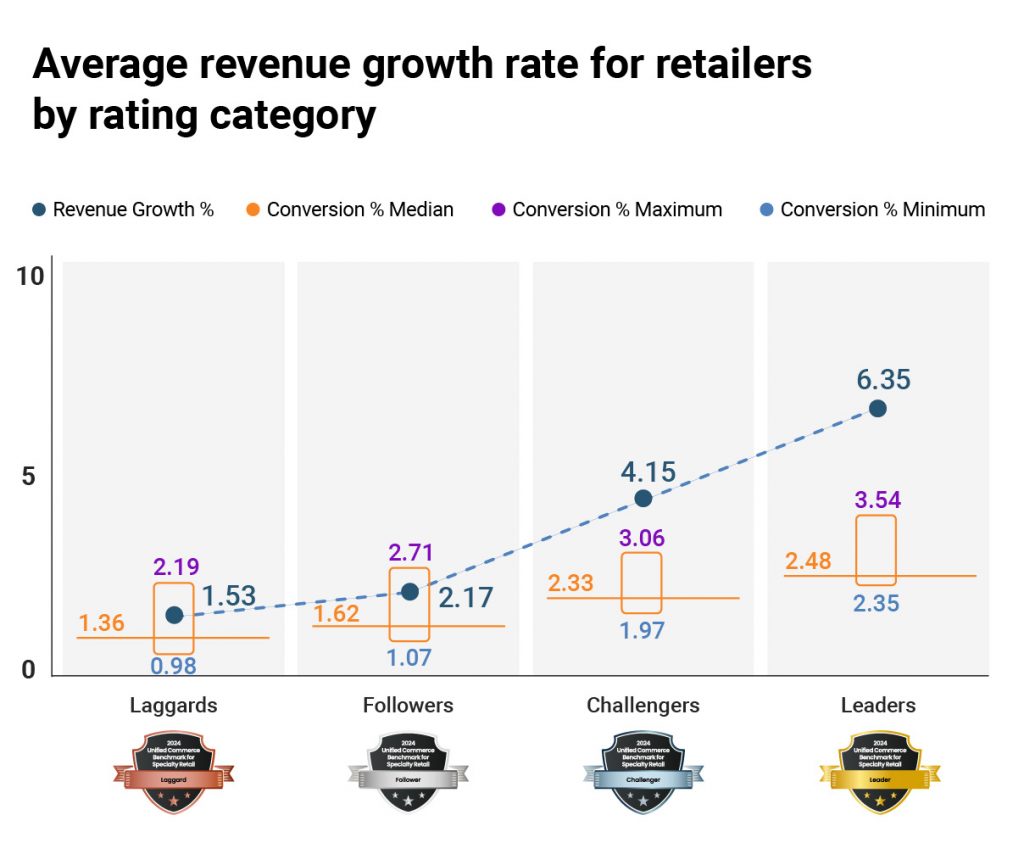
Retailers were categorised as Leaders, Challengers, Followers and Laggards. The study then revealed common attributes of successful retailers across four categories: Search and Discovery; Cart and Checkout; Promising and Fulfilment; Service and Support. So what have we learned?
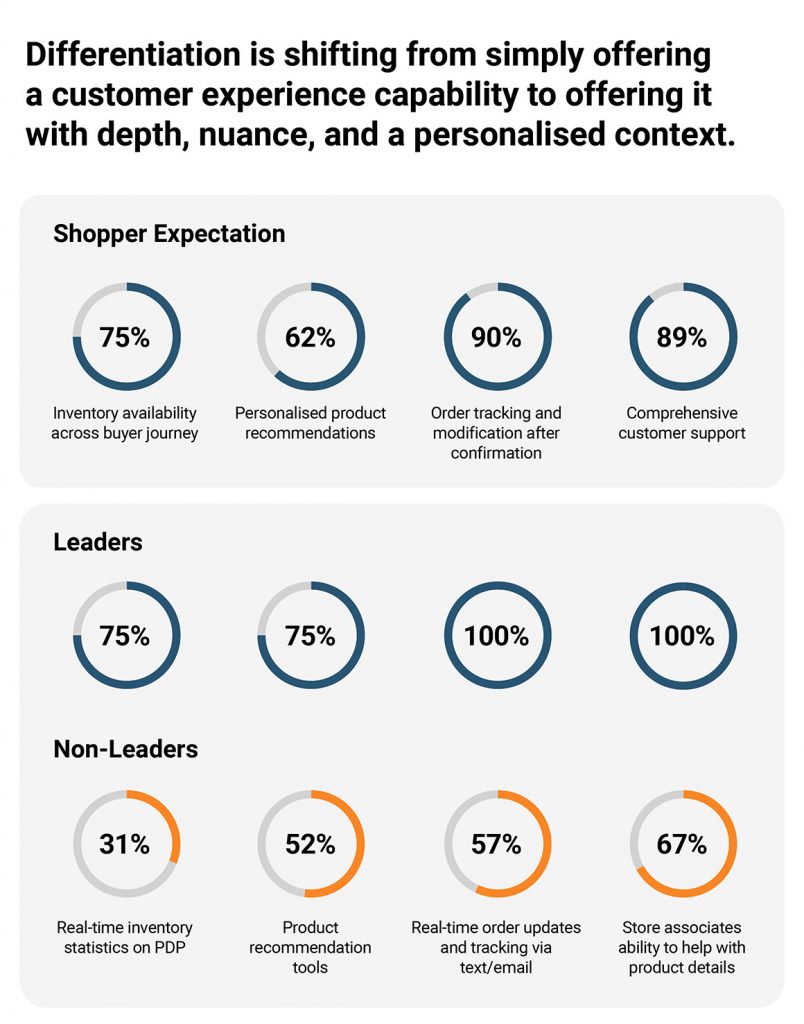
Firstly, the study called out four participating retailers as true leaders in Unified Commerce: Adidas, H&M, Leroy Merlin and M&S. These businesses aren’t just ticking boxes by offering capabilities such as real-time inventory statistics and product recommendation tools; they are actively embracing technologies that enable them to deliver more nuanced, and increasingly personalised, customer experiences.
And it’s paying off. The study found that Unified Commerce leaders’ revenue growth outperforms non-leaders by at least twofold.
Guided Inspiration, Rich Findability and Immersive StoryTelling
Leaders in ‘Search and Discovery’ help shoppers discover meaningful products, whether they are looking to fulfil an immediate need or are looking for inspiration. Most leaders in this space already bundle product offerings (offer suggestions to ‘buy the look’ or ‘buy the set’), and I imagine this will become the norm in the very near future as more retailers embrace the power of AI.
There is always room for improvement and Manhattan specifically calls out capabilities like offering real-time visibility on product description pages (PDP), inventory status callouts for low/out-of-stock items, and personalised recommendations on home page. Retailers should also strive for greater visibility of delivery times, for example by allowing shoppers to filter by fulfilment method.
Most leaders offer back-in-stock notifications and 100% of them provide product sourcing information and detailed content on sustainability practices. This is an important point – retailers must go beyond product features and really immerse the shopper in the brand’s ethos. Transparency is going to be key going forward.
The biggest point of friction in today’s retail customer experience is due to the loss of context when transiting between the physical and the digital. Those retailers leading the way in ‘Cart and Checkout’ understand that a unified cart or basket is a foundational capability when it comes to that all-important connection across channels: 40% of leaders show personalised promotions and offers on PDPs and cart, compared to 6% of non-leaders. Most leaders also allow shoppers to view promo codes in cart and check product availability status by store in cart.
Given the proliferation of payment options today, most leaders also offer checkout with buy now, pay later (100%), Apple Pay or PayPal (70%), as well as the ability to use mixed payment methods for the same order (40%).
In-store and online cart abandonment is still far too regular of an occurrence in retail. In fact, more than one-third (35%) of shoppers said that they abandon their shopping cart because of lengthy checkout process and a whopping 37% said they will not retry if asked to re-enter payment or delivery details. It’s essential that retailers provide seamless checkout experiences that reduce unnecessary friction at the point of conversion.
Flawless Fulfilment
I’ve often said that the post-purchase experience tends to be more of an afterthought than a strategic priority. Well, that is finally changing as retailers recognise that a shopper’s product pick-up or delivery experience must be as seamless as their shopping journey. Not only do leaders in ‘Promising and Fulfilment’ make sure retailers meet or beat their delivery promises consistently, they do also so while being more environmentally friendly too.
Offering shoppers greater post-order flexibility, including complete or partial cancellations, and greater delivery/pick-up options are all areas leaders excel in. Sixty percent of leaders offer shoppers the ability to cancel orders post-purchase compared to 28% of non-leaders.
And shoppers are crying out for this: more than two-thirds of shoppers want a self-service option to be able to edit order after placing them. Meanwhile, nearly three quarters (73%) of shoppers value expedited deliver (same business day) but are only willing to pay less than €5 for the service.
Manhattan calls out the ability to highlight the carbon footprint / impact of fulfilment choice as an area for improvement. Shoppers are hyper-informed when it comes to pricing and product information, but too often they are fumbling in the dark when it comes to sustainability. I believe this will change considerably over the next decade and retailers must prioritise transparency to drive greener purchasing decisions.
360 Degree Service
Leaders in the ‘Service and Support’ segment offer shoppers a wide variety of service options from call centres to in-store assistance, social media support and live agents available via their website and mobile app. What is most important, however, isn’t the breadth of support options but the fact that they offer seamless continuity, consistent quality and always-on availability.
Leaders empower shoppers to self-serve most of their needs. Nearly all (92%) offer support on order modifications, returns and exchanges via chat/call and 75% offer their customers the ability to return purchases to drop-off locations.
In addition to problem solving, leaders also offer value-added services such as customisations, style/fit guidance and in-store hospitality to turn service interactions into a secret sauce of brand stickiness. Most leaders empower their store associates to check a shopper’s online purchase history while in-store (75% compared to 48% of non-leaders). They should also be striving for in-store appointment scheduling via their digital channels, product personalisation and allowing store associates to create or manage a shopper’s wishlist.
As I have said on numerous occasions, we are witnessing a democratisation of white-glove service within the retail industry. Don’t get left behind.